UK Express Delivery in 1-2 days
Rubber Talcum Powder: The Quiet Workhorse Behind Smooth Rubber Manufacturing
Rubber manufacturing is full of loud machines, high heat, pressure, and constant motion. Yet one of the most important materials in the process works silently in the background. Rubber talcum powder does not roar, spark, or demand attention, but without it, production slows, defects increase, and costs rise.
If you work with rubber in any form, whether you manufacture industrial components, run a workshop, produce molded goods, or even handle rubber products at a smaller scale, you already know how unforgiving rubber can be. It sticks when you do not want it to. It grabs onto molds, tools, and itself. It deforms under pressure and heat. Rubber talcum powder exists to bring order to that chaos.
In this guide, we will walk through what rubber talcum powder is, why it matters, how it works, and how to use it properly. This article is written for both Business buyers who need consistency, performance, and scale, and users who want clean, reliable handling without damaging materials.
What Rubber Talcum Powder Really Is
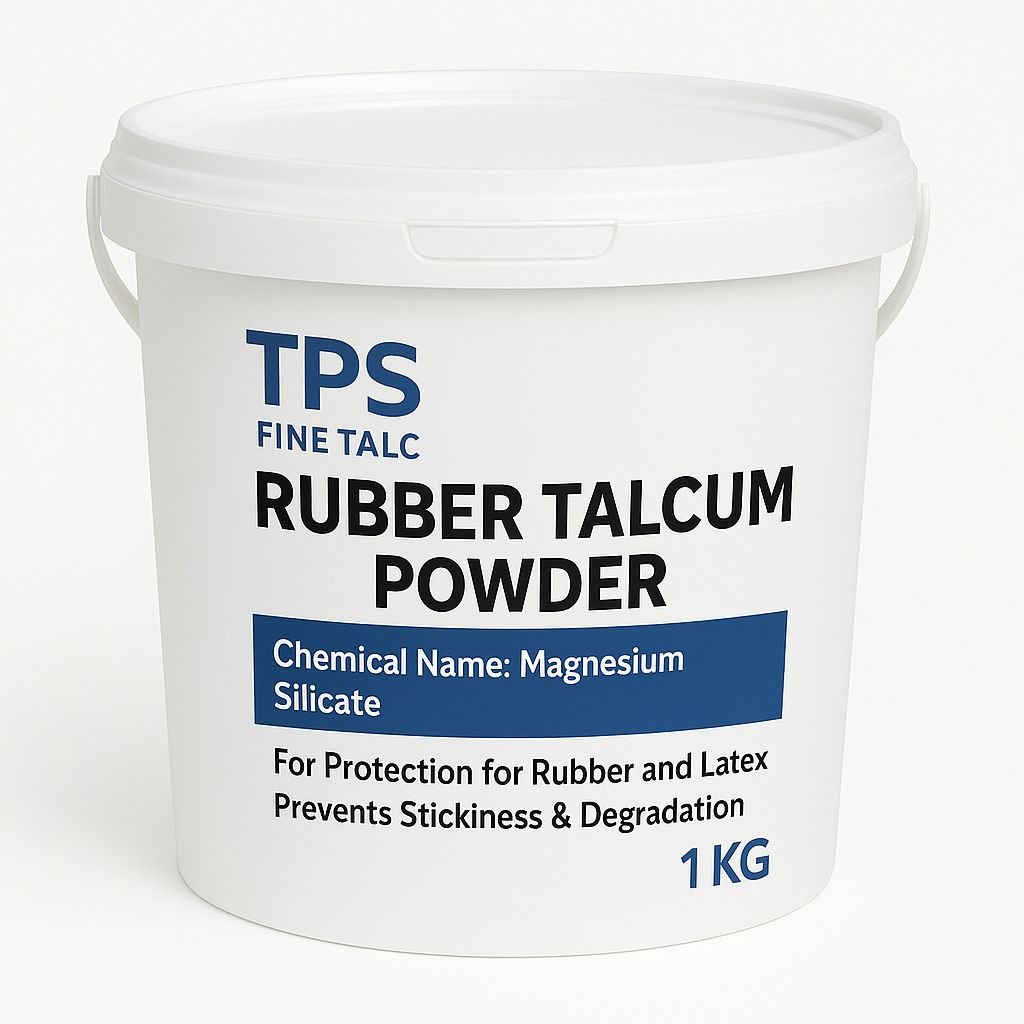
Rubber talcum powder is a highly refined, ultra-fine mineral powder designed specifically for use in rubber processing and handling. While talc is used across many industries, rubber-grade talc is engineered with one clear goal: to reduce friction and adhesion without interfering with rubber performance.
At a microscopic level, talc particles are flat and plate-like. Imagine tiny sheets of paper stacked loosely together. When applied to rubber, these particles create a smooth, dry barrier between surfaces. This barrier prevents rubber from sticking to molds, tools, conveyor belts, storage surfaces, and even other rubber parts.
Unlike general-purpose talc or cosmetic powders, rubber talcum powder is produced with controlled particle size, low moisture content, and minimal impurities. This matters because rubber processing is sensitive. Poor-quality talc can introduce defects, surface marks, contamination, or inconsistent curing.
Why Rubber Sticks — and Why That Is a Problem
Rubber is naturally elastic, soft, and reactive. These properties make it useful, but they also make it difficult to control. Fresh rubber compounds, uncured rubber sheets, and molded parts all tend to cling to whatever they touch. Heat makes this worse. Pressure makes it worse again.
In production, sticking creates a chain reaction of problems. Rubber that sticks to molds can tear during demolding. Sheets that stick together during storage become unusable. Components that grab onto tools slow down workers and increase waste. Over time, sticking causes surface damage, shape distortion, and inconsistent product quality.
Rubber talcum powder interrupts this cycle. It acts like a fine layer of ball bearings between surfaces. Instead of rubber pulling against rubber or metal, the talc allows surfaces to glide apart cleanly.
A useful way to think about it is ice on a frozen lake. You are not changing the lake itself, you are changing how things move across it.
How Rubber Talcum Powder Works in Practice
When applied correctly, rubber talcum powder forms a dry, invisible coating on the rubber surface. This coating does three important things at once.
First, it absorbs surface moisture and oils that increase stickiness. Rubber compounds often contain residual processing oils, plasticisers, or humidity from the environment. Talc captures these at the surface before they cause problems.
Second, it reduces surface friction. The flat mineral structure allows surfaces to slide past one another instead of gripping. This is critical during molding, extrusion, cutting, and stacking.
Third, it prevents direct contact between rubber surfaces. Even a thin talc layer is enough to stop rubber parts from fusing together during storage or transport.
The key is that talc does all of this without reacting with the rubber. It does not change hardness, elasticity, curing behaviour, or colour when used correctly. It simply manages the surface.
Applications Across the Rubber Industry
Rubber talcum powder is used at nearly every stage of rubber handling and production. Its role changes slightly depending on the application, but the goal remains the same: control.
In molding operations, talc is used as a release aid. It helps rubber parts separate cleanly from molds, especially in compression and injection molding. This reduces tearing, surface defects, and downtime caused by stuck parts.
In extrusion and calendering, talc prevents rubber sheets and profiles from sticking to rollers, belts, and cutting equipment. This improves line speed and reduces manual intervention.
During storage and transport, talc keeps rubber sheets, gaskets, hoses, and components from bonding together. This is particularly important in warm environments where rubber softens easily.
In workshops and maintenance settings, talc makes handling easier and cleaner. Rubber parts slide into place instead of fighting back. Assembly becomes faster and more precise.
Even at the consumer level, rubber talcum powder is used to store rubber seals, O-rings, gloves, and flexible components without damage.
Why Not Use Any Talc?
This is where many problems begin. Not all talc is suitable for rubber applications.
Low-grade talc often contains inconsistent particle sizes, excess moisture, or mineral contaminants. These issues may seem small, but in rubber processing they create real consequences. Coarse particles can imprint onto rubber surfaces. Moisture can interfere with curing. Impurities can weaken bonds or cause visual defects.
Rubber-grade talcum powder is milled and processed to tight specifications. Particle size is controlled so it spreads evenly and does not scratch or mark surfaces. Moisture levels are kept low to maintain consistency in humid environments. Purity is high to avoid chemical interference.
In simple terms, cheap talc costs more in the long run.
The Importance of Particle Size and Purity
Particle size is one of the most overlooked factors when choosing rubber talcum powder. If particles are too large, they behave like sand rather than lubricant. If they are too fine without control, they can become airborne and difficult to manage.
High-quality rubber talc uses a balanced mesh size that allows smooth coverage without excessive dusting. The powder flows easily, spreads evenly, and stays where it is applied.
Purity matters just as much. Rubber processing often involves heat, pressure, and chemical additives. Any unwanted minerals or heavy metals can react unpredictably under these conditions. This is why asbestos-free sourcing and strict quality control are non-negotiable.
When talc is pure and consistent, it becomes a reliable tool rather than a variable.
Rubber Talc vs Other Release Agents
Some manufacturers experiment with silicone sprays, oils, or chemical release agents instead of talc. While these can work in specific situations, they come with trade-offs.
Oils and sprays can migrate into rubber surfaces, affecting adhesion, painting, or bonding later in the process. They can attract dust and dirt, creating cleanliness issues. Overuse can also lead to slippery workspaces and safety concerns.
Rubber talcum powder, by contrast, is dry, inert, and controllable. It stays on the surface without soaking in. It does not interfere with downstream processes when used properly. Cleanup is simple.
Think of talc as a clean cotton glove, while oils are more like greasy hands.
How to Apply Rubber Talcum Powder Correctly
Using rubber talc well is about restraint and consistency. More is not better. A light, even coating is all that is needed.
In industrial settings, talc can be applied by dusting, brushing, tumbling, or automated powdering systems. The goal is uniform coverage without clumping. Excess powder should be avoided, as it can accumulate in molds or equipment over time.
For storage, rubber parts can be lightly dusted before stacking or packaging. This prevents sticking without leaving heavy residue.
In workshops, a small amount applied by hand or cloth is usually sufficient. The powder should disappear into the surface, not sit visibly on top.
A good rule of thumb is this: if you can see clouds of powder, you are using too much.
Health, Safety, and Modern Talc Standards
Modern rubber talcum powder is produced with safety as a priority. High-quality suppliers ensure asbestos-free sourcing, controlled dust levels, and compliance with industrial safety standards.
That said, like any fine powder, talc should be handled responsibly. Good ventilation, proper storage, and basic protective equipment help maintain a clean and safe workspace.
From a regulatory perspective, reputable rubber talc products are tested for purity and heavy metals, ensuring they meet current UK and EU standards for industrial use.
Safety today is not about fear, it is about precision and transparency.
Benefits for B2B Buyers
For manufacturers and industrial buyers, rubber talcum powder delivers value in ways that are not always obvious on a balance sheet.
Reduced scrap rates mean less wasted material. Faster demolding means shorter cycle times. Cleaner surfaces mean fewer defects and reworks. Easier handling means improved worker efficiency and less fatigue.
Over time, these gains compound. A small improvement at each stage of production adds up to significant cost savings and quality improvements.
Consistency is the real advantage. When your talc behaves the same way every time, your process becomes predictable.
Benefits for B2C and Small-Scale Users
For smaller businesses, workshops, and individual users, rubber talc brings control and protection.
It extends the life of rubber parts by preventing sticking, tearing, and surface damage. It makes installation and storage easier. It keeps rubber flexible instead of stressed and distorted.
If you have ever ruined a rubber seal because it stuck to itself in storage, you already understand the value.
Choosing the Right Rubber Talcum Powder
When selecting a rubber talc product, focus on a few core criteria.
Look for high purity and clear asbestos-free certification. Check particle size specifications suitable for rubber use. Ensure the powder is dry, free-flowing, and consistent from batch to batch. Work with suppliers who understand industrial applications, not just commodity sales.
A good supplier will talk about performance, not just price.
Final Thoughts: The Power of the Invisible
Rubber talcum powder is not glamorous. It does not change colour, shape, or design. Yet it quietly protects every step of rubber handling, from raw compound to finished product.
In many ways, it is like good infrastructure. You only notice it when it fails. When it works, everything else feels easier, smoother, and more reliable.
Whether you are producing thousands of molded parts a day or simply storing rubber components properly, the right rubber talcum powder makes a difference you can feel, even if you cannot see it.
In rubber manufacturing, control is everything. Rubber talcum powder is one of the simplest ways to achieve it.
Display prices in:GBP