
UK Express Delivery in 1-2 days 

Fine Talc Team | yesterday

White Label Talc: How to Launch Your Own-Brand Talcum Powder Range

You already know your customers. You know what they buy, how often they reorder and what they expect from your business. Launching an own-brand talc product gives you an opportunity to serve those customers with a product that carries your name.


For a distributor, that might mean adding a branded powder to an established trade catalogue. For a professional supplier, it could mean developing a pack size that suits customers better than the options they currently purchase. For a retailer, it may be a way to build a more distinctive product range.

White label talc can provide a practical route into that market without setting up your own powder filling operation. However, a successful launch involves more than putting a logo on a container. Product specification, packaging, documentation and repeat-order economics all deserve attention before the first batch is approved.


This guide explains how to turn an initial idea into a clear supplier brief and an own-brand product you can confidently put in front of your customers.

What is white label talc?

White label talc generally means an existing talc product supplied for sale under another business’s brand. Depending on the arrangement, the supplier may provide the powder, fill the packaging and apply your approved labels.


You bring the brand, customer relationships and route to market. The supplier provides the agreed product and the services included in your quotation.


Private label talcum powder is a closely related term. Some suppliers use “private label” to describe a more tailored product, while others use it interchangeably with white label. Neither term, by itself, tells you whether a formulation is exclusive or who owns the artwork.


The important step is to agree the actual scope. Establish whether the price covers filled and labelled units or only bulk powder. Confirm who sources the containers, whether artwork preparation is included and whether any product specification will be exclusive to your business.


Clear answers prevent a straightforward sourcing project from becoming a series of unexpected extras.

Start with the customer, then define the product


Before choosing a bottle or designing a label, decide who will buy the product and why.

“Customers who need talc” is too broad a starting point. A more useful brief might focus on an existing group of trade customers who want a manageable pack size, or professional buyers who want to reorder a familiar product through their usual supplier.


Consider how they will purchase and use it. They may buy individual units online, order full cases through a trade account or add the product to a regular delivery of other supplies. They may use it at a workstation, keep it on a retail shelf or distribute it between several sites.


Those details influence the packaging, selling price, instructions and order quantities.

For example, a distributor supplying small workshops might prioritise robust containers, clear identification and convenient case quantities. A brand selling through independent retailers may place greater emphasis on shelf presentation and the space available for product information.


Starting with one clearly defined customer group makes the first product easier to specify and evaluate.


Decide between bulk supply and finished branded units


Buying bulk talc and buying a finished own-brand product are different purchasing decisions.


With bulk supply, your business or a separate packing partner takes responsibility for the next stages. These may include sourcing containers, filling them, applying labels, identifying batches and preparing orders for dispatch.


With finished branded units, more of those activities sit within the supplier’s agreed scope. This can simplify coordination, although you should still establish who approves the product, packaging and final artwork.


The right arrangement depends on your existing capabilities. A business with an established packing operation may prefer bulk supply. A distributor introducing its first own-brand powder may find finished units more practical.


Compare quotations on the same basis. A price per kilogram for loose powder cannot be compared directly with a price for a filled, sealed and labelled product ready for your warehouse. Ask each supplier to explain what is included so you can assess the full cost of the arrangement.


Agree the specification before approving the branding


An attractive label cannot make up for an unclear product specification.


Tell your supplier the intended application, target customer and country of sale. Ask them to identify the proposed grade and provide the information needed to assess it against your requirements.


Avoid treating a single headline figure, such as purity or mesh size, as a complete purchasing specification. Agree which characteristics matter for your product and how they will be documented.


Your supplier discussion should also cover consistency. If a customer reorders your brand six months later, you need to understand what controls help ensure they receive the product you previously approved. Establish how proposed changes to the material or packaging will be communicated and whether they require your approval before production.


Keep a written record of the approved specification and sample. That record gives both businesses a shared reference for future orders and helps resolve questions if a later delivery differs from expectations.


For a broader introduction to available materials, explore the Fine Talc product range. For an own-brand project, the next step is to discuss your specific requirements.


Choose packaging around everyday use


Packaging needs to work throughout the product’s journey, from filling and transport through to storage, sale and use.


A container that looks impressive in a design mock-up may be awkward to handle or unsuitable for your distribution route. Equally, a practical trade pack may need a different presentation if you intend to sell it through retailers.


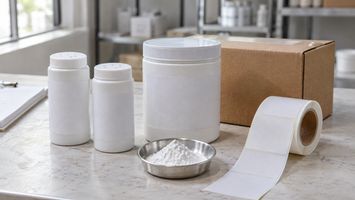
Ask for a filled packaging sample where possible. Check how the closure works, how the product dispenses and whether the label remains readable during normal handling. Consider the outer carton too, particularly if customers will order full cases or if individual products will be dispatched by courier.


Net weight and container capacity should be assessed together. A container’s stated volume does not, by itself, confirm the weight of powder it will accommodate. Confirm the proposed fill with your supplier before ordering packaging or finalising the label dimensions.


For the first launch, consider one principal pack size. Every additional size adds another combination of containers, labels, stock and reorder decisions. Expand the range when customer demand gives you a clear reason to do so.


Understand what determines the minimum order


There may be more than one minimum order quantity in a white label project.

The powder supplier may be able to provide a modest quantity of material, while the selected container, printed label or filling arrangement requires a larger commitment. A bespoke packaging component may have a different minimum from a standard stock option.


Ask which part of the project sets the minimum and whether alternatives are available. A different container or label format may change the quantity needed to make the first run practical.


It is also useful to separate the minimum quantity you must purchase from the quantity you expect to sell. Ordering more may reduce the quoted unit cost, but it also leaves more money tied up in stock.


A sensible first order should reflect a realistic sales plan. Existing customer enquiries, trial orders and discussions with distributors are more useful starting points than an ambitious forecast with no supporting demand.


Compare the full cost of bringing the product to market


The filled unit price is only one part of the commercial picture.

Depending on the arrangement, you may also need to budget for artwork, label setup, packaging components, product assessment, freight, storage and fulfilment. Establish which costs are included in the quotation and which will be invoiced separately.


Request a breakdown that distinguishes one-off setup charges from repeat-order costs. This helps you understand whether the first batch is unusually expensive and what a routine replenishment order might cost.


Work backwards from your intended sales channel. A product sold directly through your website has a different cost structure from one sold to a wholesaler who then supplies retailers. Your pricing needs to leave room for the businesses involved in getting the product to the final customer.


Consider how delivery charges affect smaller orders and whether your planned case quantities suit trade customers. These details can influence whether the product remains commercially attractive after the initial launch.


The aim is to build a product you can continue supplying at a price your customers understand.


Agree documentation and responsibilities early


Before approving production, establish which technical, safety and batch documents will accompany the proposed product.


Ask what evidence supports any claims you intend to print. Wording such as “asbestos-free” or statements about suitability for a particular application should be supported by appropriate documentation for the material being supplied.


Also agree how batches will be identified and how your business can trace a delivered unit back to its supply records. Your team should know where those records are kept and who to contact if a customer requests further information.


If the proposed product is intended for cosmetic use, clarify who will arrange the relevant assessment, documentation and label review for the intended market. Do not assume that purchasing a suitable raw material means a finished branded product is ready for sale.


Make these responsibilities part of the project brief. They are easier to resolve before artwork is printed and stock is packed.


Approve the finished pack before scaling up


A powder sample and a finished product sample answer different questions.

The powder sample helps you assess the proposed material. The finished sample shows how that material, container, closure and label work together.


Review the complete pack before committing to a larger production run. Check the product name, net weight, approved wording, batch information and artwork position. Test any barcode you intend to use and assess how the product arrives after transport.


Where practical, gather feedback from a small number of intended customers. Find out whether the pack size is convenient, whether the product is easy to identify and whether the closure suits the way they work. Specific feedback is more useful than simply asking whether they like the packaging.


Record the approved version so that future orders have a clear reference. Keeping an approved finished sample can also help your team check subsequent deliveries.


What to include in a white label talc enquiry


A well-prepared enquiry helps a supplier return a useful proposal. You do not need every detail finalised, but you should provide enough information for the supplier to understand the project.


Start with your business name and explain how you intend to sell the product. A supplier will benefit from knowing whether you operate an online shop, supply professional customers, distribute to retailers or purchase for an established trade network.


Describe the intended use and the country where the product will be sold. This gives the supplier a starting point for discussing the proposed material and the documentation you may need.


Include your preferred net weight and packaging style, even if these are provisional. If you have not chosen a container, explain how your customers will handle and use the product so suitable options can be discussed.

Provide an estimate of your first order and likely repeat demand. You do not need to promise a fixed annual volume, but an honest indication of expected sales helps the supplier prepare a more relevant quotation.


Make clear whether you need bulk powder or finished units that are filled and labelled. Explain whether your artwork is ready, whether you already have packaging suppliers or whether you need support identifying suitable options.


Finally, share your target launch date and any specific documentation requirements. If a requirement is flexible, say so. Being open to a standard container or a different case quantity may give the supplier more options to quote.


Discuss your own-brand talc project with Fine Talc


At Fine Talc, we offer personalised supply options, packaging selection and white labelling services. Our talc supply and packaging services provide a starting point for businesses exploring an own-brand range.

Tell us what you want to sell, who will buy it and how you would like it presented. We can then discuss the proposed product, packaging requirements and scope of supply, with quantities, pricing and lead times confirmed for your enquiry.


Whether you are adding a single product to an established catalogue or planning a new branded range, a clear brief is the first step.

Contact Fine Talc to discuss your white label talc requirements, or email info@finetalc.co.uk with your intended application, preferred pack size and estimated order quantity.


Fine Talc Team

More Posts

Meet Fine Talc at the Paper & Tissue Show LondonMeet Fine Talc at the Paper & Tissue Show London
Meet Fine Talc at the Paper & Tissue Show London

Fine Talc Ltd will be at the Paper & Tissue Show London on 11–12 November 2026 at ExCeL London. Over the same two days we will also be at the co-located Packaging & Recycle Show and at The Business Show London. Wherever you are on the campus, we are easy to find.


If you make paper, tissue, board, packaging, rubber or plastic compounds, we want to talk. Fine Talc is a UK supplier of A+ grade, asbestos-free talc in industrial, pharmaceutical, cosmetic and food grades. We pack from 100 g sample packs up to 25 kg trade bags, and we work with SME manufacturers who need a responsive supplier rather than a minimum order built for a multinational.


This is the first UK edition of the Paper & Tissue Show, and it falls in the same week as London Pulp Week. Below you will find what each show covers, what talc does for paper, tissue and packaging, and how to book time with our team.


Talcum Powder for Waxing: Why It Works and How to Use ItTalcum Powder for Waxing: Why It Works and How to Use It
Talcum Powder for Waxing: Why It Works and How to Use It

Ask any beauty therapist what separates a clean, quick wax from a sticky, painful one and most will say preparation. Wax is designed to grip hair, but sweat and natural skin oils get in the way: the wax slides over the hair and sticks to the skin instead. A light dusting of talcum powder before waxing is one of the simplest ways to fix that, and it has been a standard step in treatment rooms for decades.

This guide explains why talc works, how to use it with hard wax, strip wax and sugar paste, and how to choose the right talc, whether you wax at home or run a busy salon.

Talcum Powder Buyer's Guide: Grades, Uses and SafetyTalcum Powder Buyer's Guide: Grades, Uses and Safety
Talcum Powder Buyer's Guide: Grades, Uses and Safety

Talcum powder is one of the most versatile everyday minerals. The same soft white powder sits in bathroom cabinets, make-up bags, gym bags, food factories and rubber plants.


This guide covers what talcum powder actually is, the different grades, what each one is used for, what the latest science says about safety, and how to buy genuinely asbestos-free talcum powder.


At Fine Talc, we supply A+ grade, asbestos-free talc to UK households and businesses, from 100g packs to 25kg trade bags. Everything below is written to help you choose the right product, whether or not you buy it from us.


Talc for Rubber: The Complete Guide to Rubber-Grade TalcTalc for Rubber: The Complete Guide to Rubber-Grade Talc
Talc for Rubber: The Complete Guide to Rubber-Grade Talc

This guide is written for compounders, technical managers and buyers at UK rubber manufacturers. It explains what rubber-grade talc is, what it does inside a compound, where it is used, which specifications to check on a data sheet, and how to choose a supplier you can rely on batch after batch.


Rubber talc is a finely ground, plate-shaped mineral filler that rubber manufacturers use for three jobs at once: as an anti-tack dusting agent, as a processing aid and as a semi-reinforcing filler. Used well, it stops uncured compound sticking together, gives smoother extrusions with cleaner edges, and lowers compound cost without a large drop in physical properties.

Talc in Polypropylene Compounding: The Filler That Buys You Stiffness, Heat Resistance and Faster CyclesTalc in Polypropylene Compounding: The Filler That Buys You Stiffness, Heat Resistance and Faster Cycles
Talc in Polypropylene Compounding: The Filler That Buys You Stiffness, Heat Resistance and Faster Cycles

Talc is one of the most cost-effective ways to turn commodity polypropylene into a stiffer, more heat-stable, faster-moulding compound. Here's how it works — and how to pick the grade that actually delivers for your application.